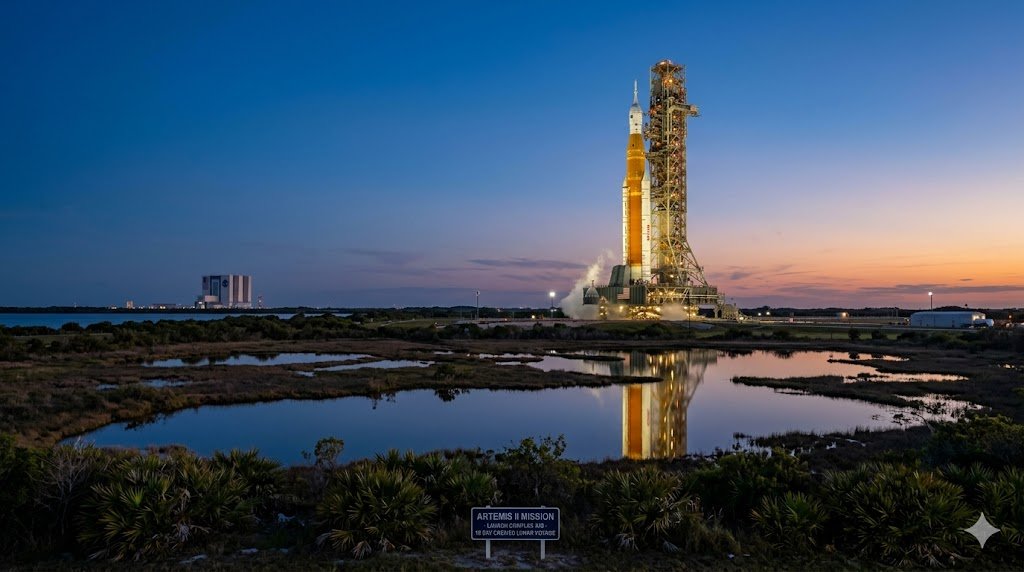
Humanity’s Return to the Deep: Artemis II Officially Launches Historic Lunar Voyage
KENNEDY SPACE CENTER, FL — For the first time in over five decades, humans are once again traversing the void toward the Moon. On April 1, 2026, at 6:35 p.m. EDT, NASA’s Space Launch System (SLS) rocket—the most powerful ever built—successfully ignited, carrying the Orion spacecraft and a crew of four into history.
This mission, Artemis II, is not just a flight; it is a rigorous 10-day “shakedown” of NASA’s deep-space capabilities. It marks the first time since Apollo 17 in 1972 that a crewed vessel has ventured beyond low Earth orbit, signaling the start of a permanent human presence in the lunar neighborhood.
A Crew of Pioneers
The four-person crew represents a deliberate shift toward more inclusive and international exploration:
- Commander Reid Wiseman: A veteran Navy test pilot leading the mission.
- Pilot Victor Glover: Making history as the first person of color to travel to the Moon.
- Mission Specialist Christina Koch: The first woman to embark on a lunar voyage, holding the record for the longest single spaceflight by a woman.
- Mission Specialist Jeremy Hansen: The first non-American (Canadian Space Agency) to leave Earth’s immediate orbit.
The 10-Day Mission Architecture
The mission is a high-stakes series of orbital maneuvers designed to test every system that will eventually support a lunar landing.
- Earth Orbit Phase (Days 1–2): After launch, the Orion spacecraft (christened Integrity by the crew) entered a high-Earth orbit to test life-support, communication, and manual navigation. A critical “proximity operations” test was conducted on April 2, where the crew manually maneuvered Orion near the rocket’s upper stage to simulate future docking procedures.
- The Lunar Push: On the evening of April 2, 2026, Orion completed its Translunar Injection (TLI) burn—a nearly six-minute engine ignition that accelerated the craft to escape velocity, officially slinging it toward the Moon.
- The Far Side Flyby (Expected April 6): Orion is set to follow a “free-return” trajectory, looping around the far side of the Moon. At its farthest point, the crew will be approximately 406,841 km (252,799 miles) from Earth, breaking the distance record set by Apollo 13.
- Return and Splashdown: The mission concludes with a high-speed atmospheric reentry on April 10, 2026, with a planned splashdown in the Pacific Ocean near San Diego.
The Road to Artemis IV and Mars
While Artemis II will not land on the surface, its success is the prerequisite for everything that follows. NASA recently adjusted its roadmap to prioritize safety and technical refinement:
- Artemis III (2027): Now designated as an Earth-orbit demonstration to test commercial lunar landers from SpaceX and Blue Origin.
- Artemis IV (2028): Targeted as the mission that will finally return human boots to the lunar soil.
By “shaking down” the hardware now, NASA is laying the groundwork for the Lunar Base (which recently replaced the shelved “Lunar Gateway” space station concept) and the ultimate horizon goal: sending humans to Mars in the 2030s.
For the millions who sent their names to the Moon via NASA’s digital archive, this mission is a reminder that the “giant leap” is no longer a memory—it is a current event.
Keywords: Artemis II mission, NASA Moon launch 2026, Orion spacecraft Integrity, Reid Wiseman, Christina Koch lunar mission, SLS rocket launch, human space exploration, return to the Moon.