Cavite BRT Set for May Launch: A New Pulse for Southern Commutes
[IMUS, Philippines] — The persistent gridlock defining the Cavite-Manila corridor is facing a structural shift. Megawide Construction Corp. has confirmed that partial operations for the P1.87-billion Cavite Bus Rapid Transit (CBRT) system are targeted to begin this May. This initial rollout marks the first tangible phase of a 30-year joint venture aimed at formalizing the chaotic transit landscape of one of the Philippines’ fastest-growing provinces.
Phase 1: Infrastructure and Immediate Reach
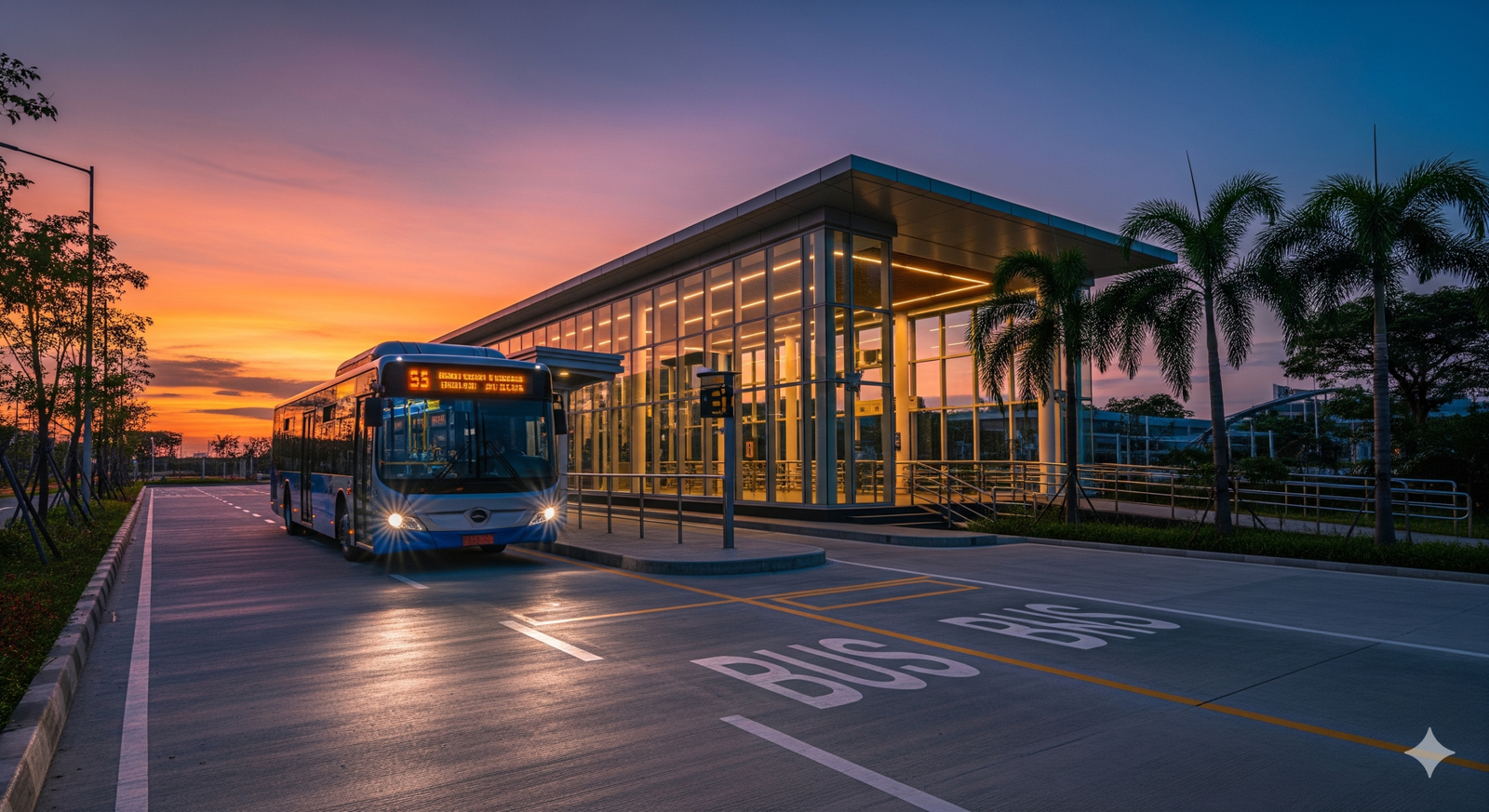
The May launch prioritizes a Point-to-Point (P2P) service connecting Imus directly to the One Ayala terminal in Makati. This segment serves as the vanguard for Phase 1, which eventually scales to include three major terminals and 27 stations. The route is designed to pierce through high-density hubs in Kawit, General Trias, and Tanza.
By deploying an initial fleet of 10 specialized buses, the project aims to serve nearly 5,000 daily passengers immediately, with capacity scaling to 10,000 as the system stabilizes. Unlike traditional jeepney or bus routes, the CBRT utilizes dedicated lanes to ensure schedule reliability—a critical metric for a workforce currently losing hours to unpredictable congestion.
The Strategic Partnership and Connection
Formalized in early 2025, the project is a tripartite agreement between the Provincial Government of Cavite, Megawide, and the Maplecrest Group. The engineering logic centers on the Parañaque Integrated Terminal Exchange (PITX), which Megawide already operates. By syncing the CBRT with PITX, the system creates a seamless “spine” for southern mobility.
The 29-kilometer total alignment is split into two development brackets. While Phase 1 tackles the coastal and central lowlands, Phase 2 will extend the reach to Trece Martires, adding another 20 stations and a fourth terminal. The long-term objective is a system capable of handling 80,000 passengers daily by the time full operations commence in 2028.
Why it Matters: Economic Integration
Beyond simple transit, the CBRT represents a shift toward transit-oriented development (TOD). A significant portion of the route traverses the spine road of Lancaster New City, integrating residential hubs directly into the mass transit network. For Cavite, which has long functioned as a “bedroom community” for Metro Manila, this infrastructure is the first step toward reducing the “distance tax” paid by residents in both time and fuel.
The project also serves as a critical proof-of-concept for private-sector-led mass transit in the Philippines. With a total project value of P1.87 billion (approximately $31 million), the CBRT is a lean, high-impact alternative to more expensive and time-intensive rail projects, offering a blueprint for other high-growth provinces.
The Takeaway
The Cavite BRT isn’t just adding more buses to the road; it is installing a predictable rhythm into a region defined by transit volatility. For the Lifestyle Alley reader, this translates to reclaimed time and reduced cortisol. The success of the May pilot will be the litmus test for whether the Philippines can successfully pivot to integrated, privately-managed bus systems to solve its urban mobility crisis.
Keywords: Cavite BRT, Megawide, public transport Philippines, commuter news, infrastructure development, PITX, bus rapid transit.